Buying: legal and financial
How to buy a high-end property: complete 2026 guide
A legal and financial guide to buying a high-end property in Curitiba: step by step, documentation, ITBI, financing, holding companies, and due diligence.
By Pedro Carvalho and Fernando Moreno

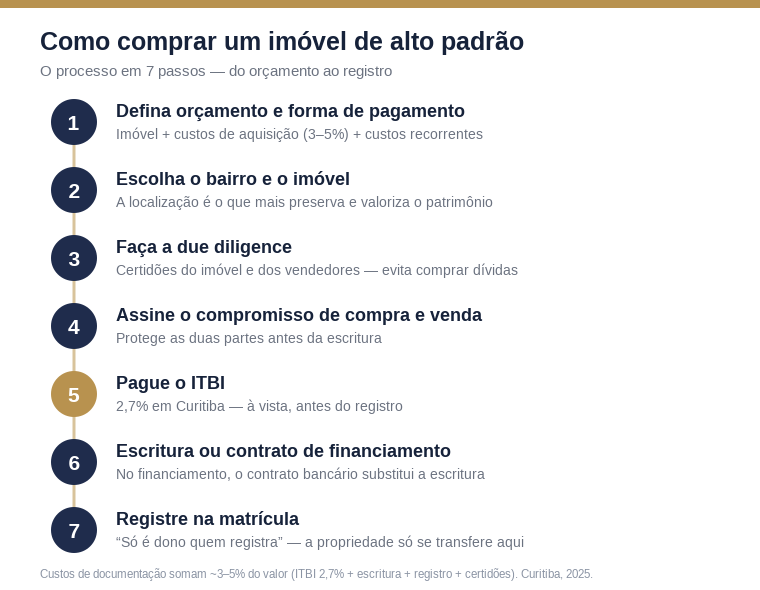
Quick answer: buying a high-end property safely involves seven steps: setting your budget and payment method, choosing the neighborhood and the property, doing due diligence (certificates for the property and the sellers), negotiating and signing the purchase and sale agreement, paying the ITBI (the property transfer tax; 2.7% in Curitiba), executing the deed (or signing the financing contract, which replaces it), and registering the purchase on the property registration (matrícula). In the documentation, the ITBI is the part you calculate yourself (2.7% of the tax base); the deed and registration are not percentages of the property's value — they are schedule amounts, in the thousands, set by bracket of the transaction's value in Paraná State Law No. 21.869/2023, to be confirmed with the notary office. For large tickets, it is worth considering a purchase through a holding company and working with a real estate lawyer.
Buying a property worth millions of reais is not the same as buying an ordinary property. A large ticket calls for more legal care, financial planning, and wealth strategy. This guide covers the whole process, from the budget to the key handover, so you can decide with confidence.
Step 1 — Set your budget and payment method
Before visiting properties, decide how much you can commit. Add to the property price the acquisition costs, renovation/decoration, and recurring costs (condominium fee, IPTU — the municipal property tax — and maintenance). In the acquisition, the number you calculate yourself is the ITBI: 2.7% of the tax base in Curitiba (Art. 9 of Municipal Complementary Law No. 108/2017) — with a base of R$ 2 million, that's R$ 54 thousand. The deed and registration are not percentages of the property's value: they are schedule amounts, in the thousands, set by bracket of the transaction's value in Paraná State Law No. 21.869/2023 — ask the notary office for the fee breakdown for your case. Also add FUNREJUS (a judiciary fund fee of 0.2% of the title value, charged only once per transaction and subject to a cap) and the certificates, charged per document. In the high-end market, the condominium fee and IPTU also weigh — include them in the calculation.
When it comes to payment, there are three paths:
- Cash: greater negotiating power and lower costs (no interest).
- Financing: preserves liquidity and capital to invest; see Step 6.
- Swap (permuta): trading one property for another (common in launches), with or without a cash top-up.
The choice between paying cash and financing is strategic and depends on the opportunity cost of your capital. For investors, keeping the money invested and financing part of the purchase can make sense — review it with your advisor.
Step 2 — Choose the right neighborhood and property
Location is the attribute that best preserves and grows your wealth. Start with the neighborhood: in Curitiba, Batel, Ecoville, Água Verde, Bigorrilho, and Cabral lead the high-end market, each with its own profile. Also decide:
- House or apartment? Vertical (Batel, Água Verde) or horizontal/gated community (metropolitan region).
- Ready or off-plan? A ready property can be used right away; off-plan tends to appreciate during construction.
- Size, en-suite bedrooms, parking spaces, and amenities that fit your lifestyle.
Understand what defines the category in high-end and luxury properties: what they are. And remember: evaluate the builder (reputation and past deliveries) as rigorously as you evaluate the property.
Step 3 — Do your due diligence (the step that protects you most)
Before signing anything, gather the documentation. This due diligence keeps you from buying a headache. Check:
- The property's up-to-date matrícula, with a lien clearance (no attachment, mortgage, or dispute).
- Seller certificates (individual and, if applicable, company): civil, labor, federal, protest, and enforcement clearance certificates.
- Property debts: IPTU and condominium fees paid up.
- Construction compliance: occupancy permit (habite-se), registry annotations, and consistency with the matrícula.
Issues here can void the deal or transfer debts to you. In the high-end market, hire a real estate lawyer — the cost is small compared with the value being protected. See the full list in documentation for buying a property.
Step 4 — Negotiate and sign the purchase and sale agreement
With the due diligence cleared, negotiate price, terms, and deadlines. The purchase and sale commitment (or promise) agreement formalizes the deal and protects both parties before the deed. It should include:
- Full identification of buyer and seller.
- A description of the property and its matrícula number.
- Price, payment method, and payment schedule.
- Deadlines, penalties, and conditions (e.g., financing approval).
- Responsibility for debts and costs.
In the high-end market, it is common to include a down payment (sinal) and guarantee clauses. Have the agreement reviewed by a lawyer.
Step 5 — Pay the ITBI
The ITBI (Imposto sobre Transmissão de Bens Imóveis, the property transfer tax) is a municipal tax and must be paid before registration. In Curitiba, the rate is 2.7% (Art. 9 of Municipal Complementary Law No. 108/2017; checked on 09/21/2026). The base is the property's assessed value: in practice, the city starts from the price declared in the deed or the financing contract, unless that amount is lower than the assessed value assigned by the city — in which case the city's value prevails. Calculate and set aside this amount from the start: without the ITBI paid, the registry office will not register the purchase. Details and calculation in ITBI in Curitiba.
Step 6 — Deed or financing contract
- Cash purchase: a public deed is executed at a notary office, signed by the buyer, the seller, and witnesses.
- Financed purchase: the financing contract signed with the bank has the force of a public deed by law — you save that cost.
Either way, registration on the matrícula is still required and, for a title subject to ITBI, the registry fees are calculated on the same valuation that served as the tax base (note 3 of Table XI of Paraná State Law No. 21.869/2023). These fees are amounts printed by bracket: no amount in the schedule exceeds R$ 1,377.24 for deeds — the bracket for transactions of up to R$ 62,602.00 — or R$ 1,194.42 for registration with a declared value — the bracket for transactions of up to R$ 54,292.00. The law prints no bracket above these: for higher-value transactions, it is the notary office or the real estate registry itself that tells you how much will be charged. FUNREJUS, at 0.2%, is also levied on the title value, only once per transaction (it cannot be charged at the notary office and again at the registry) and with a cap, and COMPREVI is already built into the fees.
How high-value financing works
Banks finance high-end properties, but with a stricter analysis: proof of income/assets, a larger down payment (often 20% to 40%), and an appraisal of the property. Compare rates, amortization system (SAC vs. Price), and term. Some banks allow part of the documentation costs to be included in the financing. For large fortunes, a private banking relationship usually offers better terms.
Step 7 — Register the property
Registration at the Real Estate Registry Office (Cartório de Registro de Imóveis) is what actually transfers ownership into your name on the matrícula. Without it, you only have possession. The market's golden rule: "only those who register are owners." Afterward, transfer the IPTU and the water and electricity accounts.
Wealth strategies for large tickets
In the high-end market, the purchase is also a wealth planning decision:
- Family holding company: buying the property in the name of a holding company can make management and succession easier and, in certain cases, bring tax efficiency. Review it with an accountant and a lawyer.
- Estate planning: deciding now how the assets will be passed on avoids future conflicts and costs (probate, ITCMD — the inheritance and gift tax).
- Diversification: real estate is part of a portfolio — balance it with other assets. See investing in luxury real estate in Curitiba.
Final checklist before signing
- Total budget (property + costs + recurring expenses) finalized.
- Neighborhood and property chosen carefully.
- Due diligence completed (clean certificates).
- Agreement reviewed by a lawyer.
- ITBI calculated and set aside.
- Payment method/financing approved.
- Registration plan and wealth structure defined.
Costly mistakes when buying high-end
- Skipping due diligence — trusting the seller and only discovering a lien on the matrícula after paying.
- Underestimating total costs — forgetting ITBI, notary fees, renovation, and the recurring costs (condominium fee, IPTU, maintenance).
- Buying on emotion — falling for the model apartment and ignoring liquidity, resale, and construction quality.
- Not evaluating the builder (off-plan) — which increases the risk of delays and post-construction problems.
- Leaving the wealth structure for later — losing succession and tax efficiency that could have been planned at purchase.
- Delaying registration — until you register, you are not the legal owner, no matter how much you have paid.
How long the buying process takes
A realistic timeline for a well-organized purchase:
| Step | Typical timeframe |
|---|---|
| Due diligence and certificates | 1–3 weeks |
| Negotiation and agreement | days to 2 weeks |
| Financing approval (if any) | 2–6 weeks |
| ITBI and deed | a few days |
| Registration on the matrícula | 1–3 weeks |
In total, 30 to 90 days for an organized cash purchase; financing lengthens the timeline. Documents in order and good advisory support shorten the path and avoid rework.
How to negotiate the price of a high-end property
Negotiation in the high-end market is less about "haggling" and more about strategy:
- Come with data — real comparables sold in the neighborhood anchor the conversation.
- Understand the seller's motivation — urgency, a move, or an inheritance define the margin.
- Negotiate beyond price — timing, what stays in the property (built-in furniture, appliances), payment method.
- Use a cash payment as leverage for a discount.
- In a launch, negotiate the price list, discount, terms, and extras (an extra parking space, a storage unit, customization).
- Don't reveal your ceiling — leave room for mutual concessions.
- Work with a broker who knows the price history and handles the negotiation discreetly.
Documentation: the short list
To close safely, gather: the up-to-date matrícula (free of liens), clearance certificates for the property and the sellers, the occupancy permit and registry annotations, proof that IPTU and condominium fees are paid, and the contract (purchase and sale agreement or financing). The full list, with costs, is in documentation for buying a property.
Questions people also ask
Can I use FGTS to buy a high-end property?
In practice, not for most high-end properties. FGTS (Brazil's employee severance fund) requires the property's appraised value to be within the ceiling of the SFH (Housing Finance System), which is R$ 2,250,000.00 since 10/10/2025 (Art. 13, item I, of CMN Resolution No. 4.676/2018, as worded by CMN Resolution No. 5.255/2025; checked on 09/28/2026). Above that appraised value, the transaction falls under the SFI (Real Estate Finance System) and the fund cannot be used. Two caveats: the ceiling applies to the appraised value, not to the financed amount or the purchase price; and being under the ceiling is not enough, because using the fund has its own conditions tied to the property and to the worker. Confirm eligibility before counting on this resource.
How long does it take to register a property in Curitiba?
Registration on the matrícula usually takes one to three weeks after the ITBI is paid and the deed is executed. The timeframe varies depending on the competent real estate registry office and how regular the documentation is. Only after registration is ownership actually transferred into your name.
What is the descriptive specification (memorial descritivo) and why does it matter when buying?
The descriptive specification is the document that details the materials and finishes the property will have at delivery. It matters because it separates what is actually contracted from what is just decoration in the model apartment. In the high-end market, checking the specification avoids frustration with items that seemed to be included and were not.
Is buying a high-end property off-plan safe?
It can be safe when the builder has a solid reputation and a track record of on-time delivery. The main risks are construction delays and market changes during construction, mitigated by choosing established developers. Check the development registration, the descriptive specification, and past deliveries before closing.
Frequently asked questions
What is the step-by-step process for buying a high-end property?
Set the budget and payment method, choose the neighborhood and the property, do the due diligence, sign the purchase and sale agreement, pay the ITBI, execute the deed (or sign the financing contract), and register it on the matrícula.
How much does buying a property cost beyond the listed price?
The part you calculate yourself is the ITBI: 2.7% of the tax base in Curitiba — with a base of R$ 2 million, R$ 54 thousand. The deed and registration are not percentages of the property's value: in the schedule of Paraná State Law No. 21.869/2023 (sole annex), they are amounts in the thousands of reais, charged by bracket of the transaction's value — it prints R$ 1,377.24 for deeds in the bracket for transactions of up to R$ 62,602.00 and R$ 1,194.42 for registration with a declared value in the bracket for transactions of up to R$ 54,292.00; above these brackets the law prints no amount, and it is the registry office that tells you how much will be charged (checked on 09/21/2026). Also add FUNREJUS (0.2% of the title value, only once per transaction and with a cap) and the certificates, charged per document. Beyond the documentation, consider any renovation and the recurring costs of the condominium fee, IPTU, and maintenance.
Is it worth buying a luxury property through a holding company?
It can be, especially for wealth management and estate planning, and in some cases for tax efficiency. The decision depends on your situation and should be reviewed with an accountant and a lawyer.
Is it better to pay cash or finance a high-end property?
Paying cash gives more negotiating power and lower costs; financing preserves liquidity to invest. The choice depends on the opportunity cost of your capital. For investors, financing part of the purchase often makes sense.
Do I need a lawyer to buy a property?
It is not mandatory, but in the high-end market it is highly recommended. A real estate lawyer handles the due diligence and reviews the contract, protecting a high-value asset at a small cost.
Buying a high-end property in Curitiba? At Antológica, you receive a written comparison and are supported at every step, from the offer to the deed. Talk to Antológica or see how we work.
Free download: the High-End Property Buyer's Guide for Curitiba: neighborhoods, costs, documentation, and a checklist of what to evaluate before buying.
Informational content by Pedro Carvalho and Fernando Moreno, partners at Antológica. It does not replace individual legal or accounting advice. Rates, fees, and rules checked on 09/21/2026 (Municipal Complementary Law No. 108/2017 and Paraná State Law No. 21.869/2023) — confirm with the City of Curitiba, the registry office, and your advisors.