Investment and appreciation
Is investing in luxury real estate in Curitiba worth it? (2026)
Is investing in luxury real estate in Curitiba worth it? See appreciation, rental returns, liquidity, risks and the best neighborhoods to invest in.
By Pedro Carvalho and Fernando Moreno

Quick answer: yes, investing in luxury real estate in Curitiba tends to be worth it. The high-end market is growing above average — the share of luxury launches nearly doubled in five years (from 6.6% in 2020 to 12.5% in 2025) — and the city's price per m² rose 15.1% in 2025. The segment offers high liquidity, lower rental vacancy and good wealth protection. The return depends mainly on the choice of neighborhood and development.
Luxury property is one of the favorite assets of those who want to protect and grow their wealth. But "worth it" depends on numbers, strategy and expectations. Here is the full analysis for Curitiba.
Why Curitiba is attractive for the high-end segment
Curitiba combines quality of life, above-national-average safety and a mature real estate market. The result shows in the 2025 data:
- A 14.3% rise in the average ticket of properties (to ~R$ 1.11 million).
- A 15.1% rise in the average price per m² (to ~R$ 9.1 thousand).
- High-end launches jumped from 6.6% (2020) to 12.5% of the total (through July 2025).
This structural — not one-off — growth is what sustains the investment thesis.
⚠️ Market data (Bem Paraná, Ademi-PR/BRAIN, 2025). Check up-to-date figures.
The 4 advantages of investing in luxury real estate
1. Wealth protection
Luxury properties tend to hold their value even in economic instability. Exclusivity and a premium location work as a store of value — a safe haven against inflation.
2. Lower vacancy and default
In high-end rentals, the tenant profile offers greater contractual security: historically lower vacancy and default, and more predictable passive income.
3. High liquidity
The segment's liquidity is among the most solid in the Brazilian market. Well-located, well-designed properties are usually sold within a few months.
4. Consistent appreciation
In certain areas, the appreciation of the price per m² of luxury properties reached up to 25% in five years. Up-and-coming neighborhoods (such as Água Verde and Cabral, which led price increases in 2025) can deliver even bigger gains.
The risks (and how to mitigate them)
No investment is risk-free. In luxury, watch out for:
- High ticket size and concentration: a single property concentrates a lot of capital. Mitigation: diversify and choose liquid neighborhoods.
- High maintenance costs and condominium fees. Mitigation: calculate the total cost of ownership beforehand.
- Construction time (off-plan): delays and market changes. Mitigation: evaluate the builder's reputation.
- Choosing the wrong neighborhood/development: the biggest risk of all. Mitigation: data and specialized advice.
Where to invest: the best neighborhoods
| Strategy | Recommended neighborhoods | Why |
|---|---|---|
| Value preservation | Batel, Bigorrilho | Scarcity, prestige, liquidity |
| Appreciation (upside) | Água Verde, Cabral, Vila Izabel | Rising strongly, more accessible ticket |
| Family rentals | Ecoville, Mossunguê | Constant demand from families |
Get to know each one in the guide Curitiba's upscale neighborhoods, in the Batel guide and in the article on living in Água Verde.
Buy off-plan or ready to move in?
- Off-plan: a lower entry price and gains from appreciation during construction, but with a timeline and construction risk.
- Ready to move in: immediate use/income and lower risk, at full price.
For investors, off-plan usually maximizes returns when the builder is solid and the neighborhood is on the rise.
How much a rented luxury property yields in Curitiba
The return on high-end residential rentals, in terms of yield (annual rent ÷ property value), usually falls within a moderate range — typically lower, in percentage terms, than that of lower-priced properties. The appeal of luxury is not a high yield, but the combination of:
- Stability: lower vacancy and default, qualified tenants.
- Asset appreciation: capital gains usually exceed current income.
- Predictability: longer contracts and better upkeep of the property.
For those seeking higher current income, luxury short-term rental (in tourist neighborhoods or on the coast) can raise the return — in exchange for more management and seasonality. Those who do not want to handle that management alone can leave it to Super Vou, an Airbnb management company in Curitiba and Antológica's partner in short-term rental management.
Luxury property vs. fixed income vs. real estate investment funds
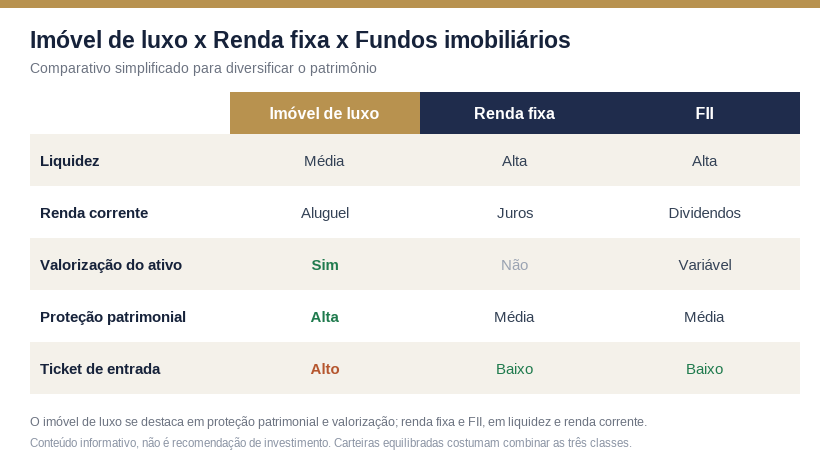
| Criterion | Luxury property | Fixed income | Real estate investment funds (FII) |
|---|---|---|---|
| Liquidity | Medium (months) | High | High (stock exchange) |
| Current income | Moderate | Variable (interest) | Monthly dividends |
| Appreciation | Good (long term) | Low | Variable |
| Wealth protection | High (real asset) | Medium | Medium |
| Entry ticket | High | Low | Low |
Physical property stands out as a store of value and a tangible asset, ideal for diversifying wealth — not for replacing 100% of the portfolio. The balance between asset classes depends on your profile and goals.
Common mistakes made by those who invest in luxury real estate
- Buying on emotion, without analyzing the neighborhood's liquidity and appreciation.
- Ignoring recurring costs (condominium fee, IPTU, maintenance) in the return calculation.
- Underestimating the importance of the builder when buying off-plan.
- Concentrating all your capital in a single asset.
- Expecting a high yield — in luxury, the gain comes more from appreciation than from rent.
Who it is (and is not) for
Investing in luxury property makes sense for those seeking wealth protection, predictable income and a medium- to long-term horizon. It is not the best option for those who need full immediate liquidity or are looking only for the highest short-term percentage return — for that, it is worth comparing it with other asset classes.
Step by step to invest in a luxury property
- Define the goal — preserving wealth, generating income or capital gains. This guides the neighborhood and the type of property.
- Set the total budget — price + acquisition costs + renovation + recurring costs. In Curitiba, the acquisition has four lines: the 2.7% ITBI (property transfer tax) on the tax base (Article 9 of Municipal Complementary Law No. 108/2017), which is the line you calculate yourself and which grows in the same proportion as the price; the FUNREJUS fee, of 0.2% of the value of the instrument, charged only once in the transaction and subject to a cap (Article 3, VII of State Law No. 12.216/1998); the deed and registration, which are not percentages of the property — they are state table amounts charged by bracket of the act's value, in the thousands, which the notary's office quotes before signing; and the certificates, charged per act.
- Choose the neighborhood by thesis — established (Batel, Bigorrilho) to preserve value; up-and-coming (Água Verde, Cabral, Vila Izabel) for appreciation.
- Analyze the asset — builder, floor plan, resale liquidity and rental potential.
- Decide off-plan vs. ready — off-plan to capture appreciation during construction; ready for immediate income.
- Run the return numbers — rental yield + expected appreciation, net of costs.
- Structure the purchase — cash, financing or a holding company, according to your wealth planning.
See the complete legal process in how to buy a high-end property.
How to diversify with luxury real estate
A classic mistake is concentrating all your capital in a single property. Experienced investors treat luxury property as one slice of a diversified portfolio — combining it with fixed income, funds and, possibly, more than one property in different neighborhoods and formats (one for stable income, another for appreciation). Diversification reduces risk and improves the overall liquidity of the portfolio.
Questions people also ask
How much do I need to invest in a luxury property in Curitiba?
The entry ticket for the high-end segment in Curitiba starts at around R$ 1 million. On top of that amount, the acquisition cost you calculate on your own is the ITBI (property transfer tax), at 2.7% (Article 9 of Municipal Complementary Law No. 108/2017): on a R$ 1 million property, R$ 27 thousand. The base is the assessed value of the property, and in practice City Hall starts from the price declared in the deed or in the financing contract, unless that price is lower than the assessed value set by the Municipality, in which case the Municipality's value prevails. The deed and registration are not percentages of the property: in Paraná they are state table amounts charged by bracket of the act's value, and the table states at the bottom that it is not progressive. No amount printed in it exceeds R$ 1,377.24 for the deed — the fee for the last bracket, that of acts up to R$ 62,602.00 — nor R$ 1,194.42 for registration with a declared value, whose last bracket is that of instruments up to R$ 54,292.00. Above those brackets the law prints no amount, so on a R$ 1 million purchase it is the notary's office that tells you how much you will pay: ask for the deed and registration quote before signing and budget for those two lines as table amounts, in the thousands of reais (Paraná State Law No. 21.869/2023, Sole Annex, tables XI and XIII; checked on 09/21/2026). These fees already include COMPREVI and, for an instrument subject to ITBI, are based on the same valuation used for the tax. Also add the FUNREJUS fee, of 0.2% of the value of the instrument, paid only once in the transaction and subject to a cap (Article 3, VII of State Law No. 12.216/1998), and the certificates, charged per act. When buying off-plan, the installment down payment and the construction payment schedule reduce the initial outlay. Also set aside cash for the recurring costs of the condominium fee, IPTU and maintenance.
Is it better to invest in one luxury property or in several lower-priced properties?
It depends on the goal: a luxury property delivers lower vacancy, a more qualified tenant and strong wealth protection, while several lower-priced properties usually deliver a higher percentage yield and spread the risk. In luxury, the gain comes more from appreciation than from rent. Experienced investors balance both strategies within a portfolio.
How long does it take to sell a luxury property in Curitiba?
Well-located high-end properties are usually sold within a few months, a liquidity considered high for the ticket size. Established neighborhoods such as Batel and Bigorrilho tend to sell faster, thanks to scarcity and constant demand. A price aligned with the market and a good presentation shorten that timeframe.
Can you rent out a luxury property short-term in Curitiba?
Yes, high-end short-term rental is an alternative for raising current income, especially for well-located properties or on the nearby coast. In exchange for a higher return, it requires more management, furnishing and living with seasonality. For predictable income and little management, traditional long-term rental is usually the better fit.
Frequently asked questions
Is luxury real estate a good investment?
Yes, especially for wealth protection and predictable rental income. It has high liquidity, lower vacancy and good appreciation — but it requires a high ticket size and a good choice of neighborhood and development.
How much have high-end properties appreciated in Curitiba?
In 2025, the city's average price per m² rose 15.1%. In certain luxury areas, appreciation reached up to 25% in five years. Neighborhoods such as Água Verde and Cabral led the recent increases.
What is the rental return on high-end property?
The rental return on luxury property tends to be more stable (lower vacancy and default) than high in percentage terms. The big appeal is predictability and tenant quality, combined with the asset's appreciation.
Is it better to buy off-plan or ready to move in to invest?
Off-plan tends to yield more when the builder is solid and the neighborhood is appreciating, because you gain during construction. Ready to move in offers immediate income and lower risk. The choice depends on your timeline and risk appetite.
What are the best neighborhoods in Curitiba to invest in?
To preserve value: Batel and Bigorrilho. For appreciation: Água Verde, Cabral and Vila Izabel. For family rentals: Ecoville and Mossunguê.
Want to invest with data, not in the dark? At Antológica you can see the price per m² by neighborhood, with our own data recorded every day, and we tell you what the number says and what it does not. Talk to Antológica or see what our data shows.
Download the free Curitiba High-End Property Buyer's Guide: neighborhoods, costs, paperwork and the checklist of what to evaluate before buying.
Content produced by Pedro Carvalho and Fernando Moreno, partners at Antológica and specialists in Curitiba's high-end real estate market. This content is for information only and is not an investment recommendation.